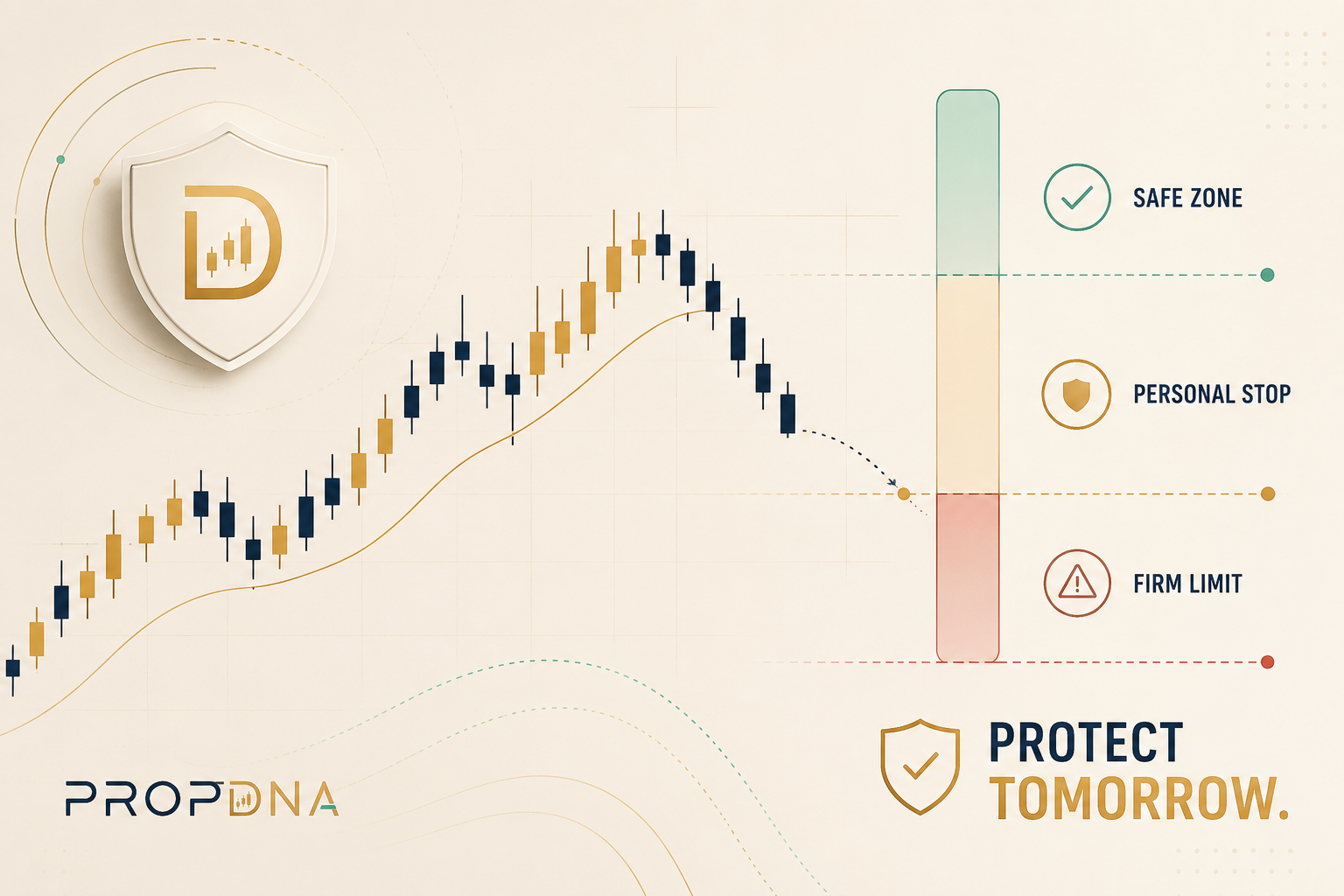
Daily loss limit in prop trading: Don’t let it paralyse you
Approaching the daily loss limit can trigger fear, hope and decision paralysis. Learn when to close your positions, step away from the charts and protect your chance to trade another day.
Approaching the daily loss limit is one of the most psychologically difficult moments in a prop trading challenge.
The account is already in drawdown. The trader knows that another adverse move could breach the firm’s rules. Yet instead of closing the position, many people freeze. They continue watching the market, hoping that the price will reverse before the limit is reached.
Sometimes it does.
Eventually, however, hope stops working.
A trader who allows one losing session to reach the firm’s daily loss limit may lose the entire challenge. A trader who closes the positions earlier and steps away from the charts can return the next day with the account still active.
That difference is not technical. It is behavioural.
The short answer
When your account approaches the daily loss limit, your priority is no longer recovering the session.
Your priority is protecting the account.
Close the positions before the firm’s limit is breached, stop trading for the day and return only after you have regained emotional control.
The prop firm’s daily loss limit should be treated as an emergency boundary. Your personal daily stop should normally be placed well before it.
A controlled losing day leaves you with another opportunity. A breached account does not.
What is a daily loss limit in prop trading?
A daily loss limit is the maximum amount a trader may lose during a defined trading day without violating the rules of a prop firm challenge or funded account.
Depending on the firm, the limit may be calculated using:
- the account balance,
- current equity,
- closed trading results,
- floating profit and loss,
- commissions,
- swaps,
- or a combination of these values.
The daily calculation may also reset at a specific server time rather than at midnight in the trader’s local timezone.
This is why every trader must understand the exact rules of the selected prop firm before placing the first trade.
In many programs, breaching the daily loss limit does not simply prevent the trader from opening another position. It results in an immediate failure of the challenge or termination of the account.
The specific calculation method always depends on the firm.
The firm’s limit is not your personal risk allowance
A common mistake is treating the entire daily loss limit as capital available for normal trading.
For example, a trader sees that the prop firm allows a 5% daily loss and concludes:
“I can lose 5% today.”
That is the wrong interpretation.
The firm’s limit is the final boundary beyond which the account fails. It is not a recommended risk budget for an ordinary session.
You should remain far enough away from that boundary to allow for:
- market slippage,
- commissions,
- floating losses,
- sudden volatility,
- delayed order execution,
- and mistakes in calculating the limit.
A personal daily loss limit should therefore be more conservative than the maximum permitted by the prop firm.
The exact distance depends on your strategy, normal position size, expected losing streak and the calculation rules of the account.
Why traders freeze near the daily loss limit
Decision paralysis rarely appears without warning.
It usually develops after a sequence of losses, when the trader becomes emotionally attached to the open position and begins treating it as the only way to save the session.
Several mechanisms may contribute to this behaviour.
Fear of accepting failure
Closing a losing position forces the trader to accept that the trade, the session or the original market analysis was wrong.
Some traders would rather remain in the position than confirm the loss.
As a result, they postpone the decision and transfer responsibility to the market.
Instead of saying, “I am closing this position,” they wait for the price to make the decision for them.
Hope that the market will reverse
The trader knows that the position should be closed but continues to think:
- “It only needs a small reversal.”
- “The market is about to turn.”
- “I will close when I get back to breakeven.”
- “One candle can save the account.”
Hope becomes a substitute for risk management.
The position is no longer being managed according to the original strategy. It is being held because the trader does not want to experience the emotional discomfort of closing it.
No predetermined exit plan
Many traders enter positions with a profit target but without a clear plan for what happens if the session deteriorates.
They may know the prop firm’s official limit, yet they have not established:
- a personal daily stop,
- a maximum number of losing trades,
- a maximum session drawdown,
- or a rule requiring them to stop trading after a certain loss.
When the situation becomes dangerous, they must make a difficult decision under maximum emotional pressure.
That is the worst possible time to invent a risk-management plan.
The urge to recover everything immediately
Once the account is down, the objective often changes.
The original objective was to trade valid setups.
The new objective becomes recovering the daily loss.
This can lead to larger positions, weaker setups, overtrading and holding losing trades for too long.
The trader is no longer asking:
“Does this trade match my strategy?”
The trader is asking:
“Can this trade bring my account back?”
A daily loss limit should protect tomorrow
The main purpose of a daily loss limit is not to punish the trader.
It is to prevent one difficult session from causing unlimited damage.
Assume that a trader is approaching the daily limit but still has room before reaching the maximum overall drawdown.
If the trader closes the open positions, accepts the controlled loss and stops trading, the account may remain active.
The next session creates another opportunity to:
- analyse the mistakes,
- return to normal position sizing,
- wait for higher-quality setups,
- and recover gradually through the trading process.
Breaching the daily limit removes that opportunity.
This is why the decision should not be framed as:
“Do I accept this loss?”
The better question is:
“Do I protect my ability to trade tomorrow?”
What should you do when you are close to the daily loss limit?
When the account approaches the danger zone, the response should already be predetermined.
1. Stop opening new positions
Do not try to solve a difficult session by increasing the number of trades.
Every additional position introduces new execution risk, transaction costs and emotional pressure.
When the personal daily stop is close, the priority should be reducing exposure rather than creating more of it.
2. Close positions before the firm forces the outcome
Do not wait until the account is only a few dollars away from the official limit.
Floating profit and loss can change rapidly. Slippage, spreads and commissions can also push the account beyond the threshold.
The closer you move toward the limit, the less control you have over the final result.
Closing earlier may feel painful, but it preserves something more valuable than the current trade: the account.
3. Cancel all pending orders
A trader may close the active position but forget about limit orders or stop orders waiting elsewhere in the market.
After reaching the personal stop, cancel all remaining orders and confirm that the account has no unintended exposure.
4. Leave the trading platform
Remaining in front of the charts creates temptation.
The trader may notice another setup, convince himself that the situation has changed and re-enter the market.
After reaching the personal daily stop, close the platform and physically step away from the desk.
The session is over.
5. Do not plan an immediate recovery trade
The next session should not begin with the objective of recovering the previous day’s loss.
That mindset can carry the same pressure into a new trading day.
Return to your normal methodology, normal risk and normal setup criteria.
A loss should be recovered through a series of valid decisions, not through one oversized trade.
Create your own daily stop before the session begins
The prop firm defines when the account fails.
You should define when you stop.
Before each trading session, know:
- your maximum personal loss for the day,
- the maximum number of losing trades,
- the maximum number of total trades,
- when position size must be reduced,
- when all positions must be closed,
- and what action ends the session completely.
These rules should be decided before the first trade, not after the account enters drawdown.
For illustration, a trader could create a risk ladder such as:
1. Normal risk while the account remains within the planned session range.
2. Reduced risk after reaching a predetermined drawdown.
3. No new positions after reaching the warning level.
4. All positions closed at the personal daily stop.
5. Trading platform closed for the remainder of the session.
The percentages must be adapted to the trader’s strategy and the prop firm’s rules. The important part is that the decision is made in advance.
Your personal stop should come before the prop firm’s limit
Assume that a prop firm has a 5% daily loss limit.
This does not mean that the trader should continue trading until the account reaches -4.99%.
Doing so leaves almost no margin for:
- changing spreads,
- execution delays,
- commissions,
- open positions,
- or an incorrect understanding of the reset calculation.
The official limit should be treated like the edge of a cliff.
A professional risk process places a barrier before the edge.
The safer distance depends on the trader and program, but the basic principle remains the same:
Never build a trading plan that requires perfect execution at the maximum permitted loss.
Floating losses can matter
One of the most dangerous misunderstandings concerns open positions.
Some traders assume that only closed trades are included in the daily loss calculation. In many prop firm programs, floating losses are also counted.
This means that the account may breach the limit even though the losing position has not yet been closed.
The calculation may also include commissions and swaps.
Additionally, holding a position through the daily reset can create unexpected consequences if the firm recalculates the limit using a new starting balance or equity value.
Never assume how the rule works.
Check:
- whether the limit is based on balance or equity,
- whether floating profit and loss is included,
- when the trading day resets,
- whether commissions and swaps count,
- whether profitable closed trades increase the daily buffer,
- and what happens to positions held through the reset.
One losing day does not define you as a trader
Many traders struggle to close positions because they interpret the loss personally.
A losing session becomes evidence that they are undisciplined, unskilled or incapable of passing the challenge.
This creates an emotional need to repair not only the account but also their self-image.
However, one session does not define the quality of a trader.
Losses are part of every trading strategy. Even a valid setup can fail, and even disciplined execution can produce a negative result.
The difference between a controlled trader and an uncontrolled trader is not the absence of losing days.
It is the response to those days.
A mature trader can say:
“The session is over. I lost within my rules. I will review it and return tomorrow.”
Closing a losing position is an active decision
There is an important difference between losing money and losing control.
A trader can finish the day with a loss while still controlling:
- the size of the position,
- the exit point,
- the maximum session drawdown,
- and the decision to stop.
When the trader refuses to act and allows the firm’s system to close or invalidate the account, control has been surrendered.
The market determined the final result because the trader refused to make the difficult decision.
Closing the position is therefore not a passive admission of defeat.
It is an active risk-management decision.
Emotional maturity in prop trading
Emotional maturity does not mean trading without fear, disappointment or frustration.
It means acting according to the plan despite those emotions.
A mature trader understands that:
- a losing trade does not need to be recovered immediately,
- being wrong is part of trading,
- protecting capital is more important than protecting the ego,
- one session should not decide the entire challenge,
- and walking away can be the best trading decision of the day.
Allowing a position to breach the daily limit because closing it feels uncomfortable is not disciplined risk-taking.
It is avoidance.
The ability to accept a controlled loss before it becomes an account failure is one of the clearest signs of professional development.
Practical rules for managing the daily loss limit
Know the exact calculation
Read the firm’s rules and confirm how balance, equity, floating losses, commissions, swaps and reset times affect the limit.
Set alerts before the danger zone
Use platform alerts or risk-management tools to warn you before the personal daily stop is reached.
Do not rely on memory while managing several positions.
Limit the number of trades
A maximum trade count can prevent a normal losing session from turning into revenge trading.
Reduce exposure after consecutive losses
If your trading plan supports it, consider reducing position size after a predetermined number of losses.
The decision should be systematic rather than emotional.
Never move the personal stop
A daily stop that moves whenever the trader approaches it is not a risk limit.
It is only a suggestion.
Record the reason the session ended
Your journal should distinguish between:
- normal strategy losses,
- execution errors,
- overtrading,
- excessive position size,
- emotional trades,
- and breaches of the trading plan.
The purpose is not self-punishment. It is identifying which behaviours must change.
Do not confuse survival with passivity
Protecting the account does not mean being afraid to trade.
It means ensuring that every session has a clearly defined maximum cost.
A trader with controlled risk can still trade confidently and take valid opportunities. The difference is that no single day is allowed to destroy the entire challenge.
Trading is not about avoiding all losses.
It is about preventing ordinary losses from becoming catastrophic ones.
The prop firm’s rules must fit your trading style
Daily loss limits are not calculated identically across all prop firms.
Two challenges may advertise the same account size and profit target while creating very different conditions for the trader.
Differences may include:
- balance-based versus equity-based drawdown,
- fixed versus trailing limits,
- daily reset times,
- treatment of floating losses,
- inclusion of commissions and swaps,
- restrictions on holding positions overnight,
- and the relationship between the profit target and permitted loss.
A strategy that works comfortably under one rule structure may become difficult to execute under another.
This is why choosing a prop firm based only on price, account size or profit split can be a mistake.
The rules should match your trading frequency, average stop size, holding period, market and risk tolerance.
That is the principle behind ThePropDNA:
The prop firm should fit the trader — not the other way around.
Conclusion: protect the account before the limit protects it for you
The daily loss limit should not be viewed as a target, a punishment or a challenge to test how much pressure you can tolerate.
It is the final safety boundary of the account.
Your own risk-management process should act earlier.
When the session approaches your personal stop:
- close the positions,
- cancel pending orders,
- leave the platform,
- accept the controlled loss,
- and protect your ability to return the next day.
The goal is not to win every session.
The goal is to remain consistent enough to trade the next valid opportunity.
A trader who stops before the limit has made a difficult but professional decision. A trader who waits for the market to decide risks turning one bad day into the end of the entire challenge.
Protecting capital today gives your strategy another chance tomorrow.
Frequently Asked Questions
What is a daily loss limit in a prop firm challenge?
It is the maximum loss permitted during a defined trading day. Depending on the prop firm, it may include closed losses, floating losses, commissions, swaps or changes in account equity.
What happens if I breach the daily loss limit?
In many prop firm programs, breaching the limit results in failure of the challenge or termination of the funded account. The exact consequence depends on the firm’s rules.
Does an open losing position count toward the daily loss limit?
It may. Many firms calculate the limit using equity, which includes floating profit and loss. Traders should verify the calculation method before opening positions.
Should I use the entire daily loss limit?
No. The firm’s limit should be treated as an emergency boundary. A trader should define a more conservative personal daily stop and stop trading before the official limit is reached.
What should I do when I am close to the limit?
Stop opening new trades, close existing positions according to your risk plan, cancel pending orders and leave the platform for the rest of the session.
Can I recover the loss the next day?
The account may still have a chance to recover if the daily and maximum drawdown rules have not been breached. Recovery should be gradual and based on normal strategy execution, not increased risk.
Why do traders hold losing positions near the limit?
Common reasons include fear of accepting a loss, hope for a reversal, lack of a predetermined exit plan and the emotional need to recover the session immediately.
How do I set a personal daily loss limit?
It should reflect your normal risk per trade, expected losing streak, strategy volatility and the prop firm’s drawdown rules. It should always leave a meaningful safety margin before the firm’s official limit.
Does the daily loss limit reset at midnight?
Not necessarily. Prop firms may use a specific server time or timezone. Positions held during the reset may also affect the next day’s calculation, so the exact rules must be checked.
Is closing the platform after a loss a good idea?
Yes. Once the personal daily stop has been reached, closing the platform reduces the temptation to revenge trade or reopen positions under emotional pressure.
---
Risk disclaimer: Prop trading and leveraged trading involve a significant risk of financial loss. Rules, drawdown calculations and account conditions vary between prop firms. This article is for educational purposes only and does not constitute financial or investment advice.